Indicators
Indicators
Value
Direction
MACD(12,26,9)
0.154
Buy
RSI(14)
57.572
Neutral
STOCH(KDJ)(9,3,3)
79.303
Buy
ATR(14)
2.424
Low Volatility
CCI(14)
122.002
Buy
Williams %R
14.739
Overbought
TRIX(12,20)
-0.007
Sell
StochRSI(14)
100.000
Overbought


366.450
Today
+0.25%
5 Days
+0.93%
1 Month
+0.26%
6 Months
+0.66%
Year to Date
-4.40%
1 Year
-5.88%
Opening Price
365.390Previous Closing Price
365.530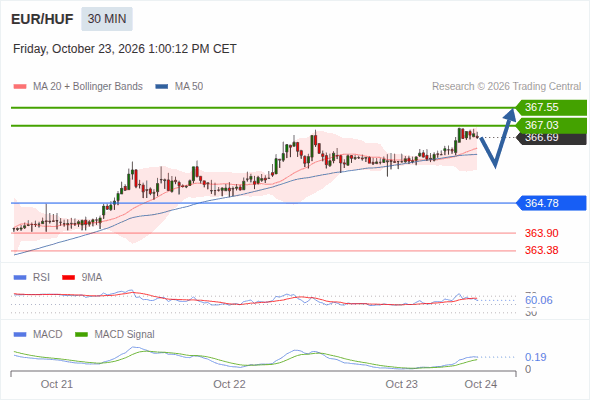
The upside prevails as long as 364.78 is support, with 367.03 and 367.55 as targets
below 364.78, expect 363.90 and 363.38.
The upside prevails as long as 364.78 is support, with 367.03 and 367.55 as targets
ING strategist Frantisek Taborsky explains that deepening global risk-off sentiment and rising energy prices are weighing on Central and Eastern European currencies, even as regional FX shows resilience.
Geoff Yu at BNY Mellon argues that Hungary has become a positive fiscal outlier in CEE, front‑loading consolidation to pursue Eurozone entry by 2030.
ING’s Frantisek Taborsky reports Hungary’s new fiscal path projects the deficit falling to 2.8% by 2030, aligned with Euro adoption plans, while the National Bank of Hungary keeps rates at 5.50% and stresses caution amid global uncertainties. EUR/HUF trades in a tight 362–364 range, with positioning corrections and future direction seen hinging on global developments and energy prices.
BNY Mellon’s Geoff Yu notes that Central and Eastern European (CEE) assets have underperformed in October, with CE3 FX (Polish Zloty, Czech Koruna and Hungarian Forint) carry versus EUR and USD lagging cash returns and reflecting markets’ belief that CEE central banks cannot match European Central B
Commerzbank’s Tatha Ghose reports that the MNB kept its base rate at 5.50% and maintained the overnight corridor, but seasonally-adjusted inflation suggests real rates may soon turn negative.
ING’s Frantisek Taborsky reports Hungary’s government has outlined a 2025 budget deficit target of 4.9% of GDP, down from 7.0–7.5%, relying on spending cuts, lower interest costs and new taxes.
The Indicators feature provides value and direction analysis for various instruments under a selection of technical indicators, together with a technical summary.
This feature includes nine of the commonly used technical indicators: MACD, RSI, KDJ, StochRSI, ATR, CCI, WR, TRIX and MA. You may also adjust the timeframe depending on your needs.
Please note that technical analysis is only part of investment reference, and there is no absolute standard for using numerical values to assess direction. The results are for reference only, and we are not responsible for the accuracy of the indicator calculations and summaries.