tradingkey.logo
tradingkey.logo
Search

WTI

USOIL
Add to Watchlist

87.000USD

+5.947+7.34%
View Detailed Chart
Time
1m
15m
30m
1h
4h
D
W
Please select

Today

+7.34%

5 Days

-3.83%

1 Month

-8.00%

6 Months

+52.29%

Year to Date

+52.16%

1 Year

+36.81%

View Detailed Chart

Key Data Points

Opening Price

88.348

Previous Closing Price

81.053
Price Range of the Day
86.46889.588
52-Week Price Range
54.870114.613

Indicators

The Indicators feature provides value and direction analysis for various instruments under a selection of technical indicators, together with a technical summary.

This feature includes nine of the commonly used technical indicators: MACD, RSI, KDJ, StochRSI, ATR, CCI, WR, TRIX and MA. You may also adjust the timeframe depending on your needs.

Please note that technical analysis is only part of investment reference, and there is no absolute standard for using numerical values to assess direction. The results are for reference only, and we are not responsible for the accuracy of the indicator calculations and summaries.


1m
5m
15m
30m
1h
2h
4h
D
W
M
1m
5m
15m
D
Neutral
Sell(4)
Neutral(3)
Buy(6)
Indicators
Sell(2)
Neutral(3)
Buy(2)
Indicators
Value
Direction
MACD(12,26,9)
-5.192
Neutral
RSI(14)
47.113
Neutral
STOCH(KDJ)(9,3,3)
26.841
Buy
ATR(14)
9.085
High Vlolatility
CCI(14)
-70.871
Neutral
Williams %R
71.004
Sell
TRIX(12,20)
0.103
Sell
StochRSI(14)
96.385
Buy
Moving Average
Sell(2)
Neutral(0)
Buy(4)
Indicators
Value
Direction
MA5
85.926
Buy
MA10
90.396
Sell
MA20
94.378
Sell
MA50
83.471
Buy
MA100
71.362
Buy
MA200
66.801
Buy

WTI Trading Strategy

Intraday
Medium Term
Short Term
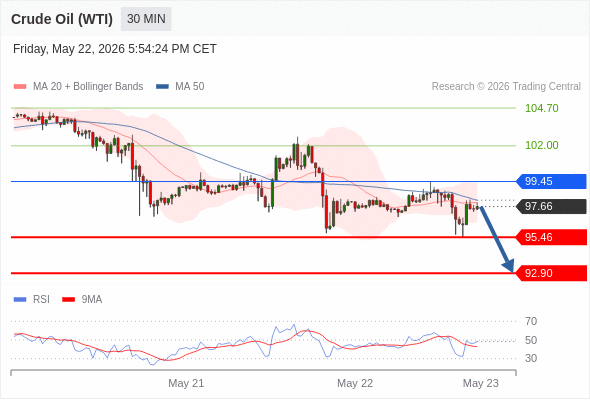
Long positions above 83.90 with targets at 88.50 & 91.80 in extension.

Trading Strategy

Long positions above 83.90 with targets at 88.50 & 91.80 in extension.

Alternative scenario

below 83.90 look for further downside with 81.75 & 79.70 as targets.

Comment

long positions above 83.90 with targets at 88.50 & 91.80 in extension.

3 hours ago
Source: Trading Central(Reference Only)

WTI News

US Pre-Market: US-Iran Standoff Weighs on Market Sentiment, Oil Surges as Safe-Haven Assets Retreat, Trump Executive Order Boosts Healthcare Against Trend

U.S.-Iran conflict drives VIX higher; WTI crude surges while safe-haven assets pull back; Marvell jumps on Google partnership; Polymarket valuation hits $15 billion; Hong Kong opens trading for tokenized funds.

TradingKey38 minutes ago
U.S.-Iran conflict drives VIX higher; WTI crude surges while safe-haven assets pull back; Marvell jumps on Google partnership; Polymarket valuation hits $15 billion; Hong Kong opens trading for tokenized funds.

WTI Oil holds around $87.00 as the US-Iran peace process teeters

Crude prices edged lower during Monday’s European trading session, with the US benchmark West Texas Intermediate (WTI) barrel changing hands at $86.85 at the time of writing. This is down from session highs at $88.50, but significantly above Friday’s lows, at $78.90.

Fxstreet3 hours ago
Crude prices edged lower during Monday’s European trading session, with the US benchmark West Texas Intermediate (WTI) barrel changing hands at $86.85 at the time of writing. This is down from session highs at $88.50, but significantly above Friday’s lows, at $78.90.

JPMorgan and Goldman Sachs Reach New Consensus: Weak Demand Is the Main Reason for Falling Oil Prices But Warn of More Intense Volatility Ahead

TradingKey - Catalyzed by repeated closures of the Strait of Hormuz over the weekend and the re-escalation of Middle East tensions, compounded by the U.S. seizure of an Iranian merchant vessel and Iran firing on commercial ships, market expectations for a de-escalation in the Middle East have cooled significantly. Goldman Sachs stated that noticeably weak oil demand—particularly for petrochemical feedstocks and jet fuel—driven by high refined product prices and margins, could lead to further declines in oil prices.

TradingKey3 hours ago
TradingKey - Catalyzed by repeated closures of the Strait of Hormuz over the weekend and the re-escalation of Middle East tensions, compounded by the U.S. seizure of an Iranian merchant vessel and Iran firing on commercial ships, market expectations for a de-escalation in the Middle East have cooled significantly. Goldman Sachs stated that noticeably weak oil demand—particularly for petrochemical feedstocks and jet fuel—driven by high refined product prices and margins, could lead to further declines in oil prices.

Oil: Strait tensions keep upside risks alive – Danske Bank

Danske Research Team highlights that Brent crude has rebounded toward USD 95/bbl as US–Iran tensions around the Strait of Hormuz intensify.

Fxstreet6 hours ago
Danske Research Team highlights that Brent crude has rebounded toward USD 95/bbl as US–Iran tensions around the Strait of Hormuz intensify.

How Will the U.S.-Iran Situation Evolve? What Is Behind the Nasdaq’s Record High?

TradingKey — Middle East conflicts escalated further over the weekend. Optimistic signals released by Trump were refuted by Iran during the two-day period. According to Reuters, the U.S. military seized an Iranian cargo ship attempting to break through its blockade, while Iran stated it would not participate in a second round of peace talks, despite U.S. President Trump's threats of a new round of air strikes. While short-term geopolitical tensions remain unclear, the market delivered a different performance: the Nasdaq recorded a 13-day winning streak and hit a new record high on April 17, reaching an intraday high of 24,519.51 points and closing at 24,468.48 points, a gain of 1.52%.

TradingKey6 hours ago
TradingKey — Middle East conflicts escalated further over the weekend. Optimistic signals released by Trump were refuted by Iran during the two-day period. According to Reuters, the U.S. military seized an Iranian cargo ship attempting to break through its blockade, while Iran stated it would not participate in a second round of peace talks, despite U.S. President Trump's threats of a new round of air strikes. While short-term geopolitical tensions remain unclear, the market delivered a different performance: the Nasdaq recorded a 13-day winning streak and hit a new record high on April 17, reaching an intraday high of 24,519.51 points and closing at 24,468.48 points, a gain of 1.52%.

Strait of Hormuz Opens and Closes Again, Gold Prices Plunge Nearly $100 at Open, Will Gold Rise or Fall This Week?

TradingKey - Amid the geopolitical tug-of-war surrounding the Strait of Hormuz last week, gold prices experienced sharp volatility. Although gold prices plunged at the market open this week, technical analysis still indicates a higher probability of an upward trend.

TradingKey6 hours ago
TradingKey - Amid the geopolitical tug-of-war surrounding the Strait of Hormuz last week, gold prices experienced sharp volatility. Although gold prices plunged at the market open this week, technical analysis still indicates a higher probability of an upward trend.

More Details of WTI

USOIL, commonly referred to as West Texas Intermediate (WTI) crude oil, is a light, sweet crude oil that serves as one of the primary benchmarks for oil pricing in the global market. Sourced primarily from oil fields in the United States, particularly in Texas and Oklahoma, WTI crude oil is known for its API gravity of around 39.6 degrees, which classifies it as ‘light,’ and its low sulfur content, which makes it ‘sweet.’ These characteristics make WTI crude highly desirable for refining into gasoline, diesel, and other high-value petroleum products. The price of USOIL is set on the New York Mercantile Exchange (NYMEX) and is traded in the form of futures contracts, which allow market participants to buy and sell the commodity for delivery at a future date. These contracts are standardized, with each representing 1,000 barrels of crude oil. The USOIL futures market is one of the most liquid in the world, attracting a diverse range of traders, including producers, refiners, hedge funds, and individual investors. The price of USOIL is influenced by a complex interplay of factors, including: Global supply and demand dynamics: Fluctuations in oil production, particularly from major producers like the United States, Russia, and Saudi Arabia, as well as changes in global consumption patterns, can significantly impact prices. OPEC and non-OPEC production quotas: Decisions by the Organization of the Petroleum Exporting Countries (OPEC) and its allies to increase or decrease oil production can cause substantial price movements. Geopolitical events: Conflicts, sanctions, and political instability in oil-producing regions can lead to supply disruptions and volatility in oil prices. Economic indicators: The health of the global economy, as indicated by GDP growth rates, industrial production, and other economic data, affects the demand for oil and, consequently, its price. Inventory levels: Reports on oil stockpiles, particularly those published by the American Petroleum Institute (API) and the Energy Information Administration (EIA), can influence prices based on whether they show a surplus or a deficit in supply. Currency fluctuations: Since oil is traded in U.S. dollars, movements in the value of the dollar can affect the price of oil in other currencies, influencing international demand. Given its importance in the global energy market, USOIL is a key commodity for traders looking to speculate on price movements or hedge against oil price volatility. However, trading USOIL can be risky and requires a solid understanding of the market forces at play, as well as careful risk management.

What is US OIl?

As the primary benchmark for the US energy market, WTI Crude (US Oil) is a premium 'light and sweet' grade favored by traders for its high liquidity. It remains a critical indicator for global oil price volatility and a staple for commodity futures on the NYMEX.

What's the current price of US Oil?

The opening price of US Oil (WTI) on March 5, 2026 was $76.82/bbl.

What is WTI all time high?

The WTI all time high is $410.45/bbl (Dec 2025).

How does the price of USOIL fluctuate?

The price of USOIL can fluctuate due to several factors, including global supply and demand, OPEC production levels, geopolitical tensions, economic growth, currency fluctuations, and changes in inventory levels.

Can individual investors trade USOIL?

Yes, individual investors can trade USOIL through futures contracts, options, exchange-traded funds (ETFs), and other derivative instruments. However, trading commodities can be risky and is best suited for experienced investors.

What is the main difference between USOIL (WTI) and UKOIL(Brent crude oil)?

USOIL (WTI) and Brent crude are the two major global oil benchmarks. The primary difference is their location and quality. WTI is produced in the United States and is lighter and sweeter (less sulfur) than Brent, which is produced in the North Sea and has a slightly higher sulfur content.

WTI

87.000
+5.947+7.34%
KeyAI