Indicators
Indicators
Value
Direction
MACD(12,26,9)
0.250
Neutral
RSI(14)
50.388
Neutral
STOCH(KDJ)(9,3,3)
69.864
Neutral
ATR(14)
0.886
High Vlolatility
CCI(14)
49.969
Neutral
Williams %R
25.645
Buy
TRIX(12,20)
-0.027
Sell
StochRSI(14)
54.788
Buy


110.612
Today
+0.29%
5 Days
+0.85%
1 Month
+0.11%
6 Months
-2.87%
Year to Date
+5.78%
1 Year
+11.22%
Opening Price
110.404Previous Closing Price
110.300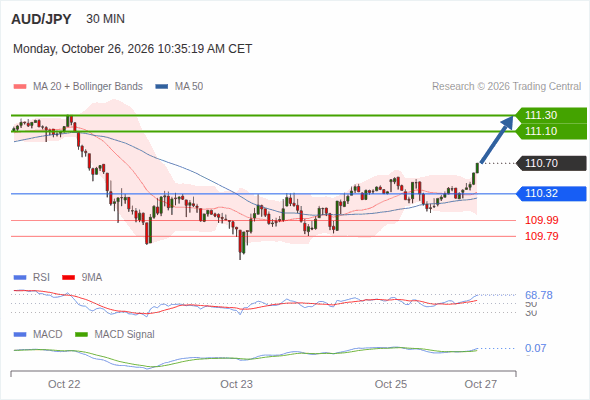
The upside prevails as long as 110.32 is support, with 111.10 and 111.30 as targets
below 110.32, expect 109.99 and 109.79.
The upside prevails as long as 110.32 is support, with 111.10 and 111.30 as targets
The AUD/JPY cross trades in negative territory around 110.35 during the early European session on Monday. The Japanese Yen (JPY) strengthens against the Australian Dollar (AUD) as hawkish language may reinforce expectations that the Bank of Japan (BoJ) will raise interest rates this year.
The AUD/JPY cross trades in negative territory around 110.10 during the early European trading hours on Friday.
The AUD/JPY cross trades in negative territory around 110.60 during the early European trading hours on Thursday. Hawkish remarks from Japanese authorities provide some support to the Japanese Yen (JPY) against the Australian Dollar (AUD).
The AUD/JPY surges for the fourth straight day and approaches key resistance levels as bulls gather momentum, hitting a new monthly high above the October 14 daily high of 111.13. The cross-pair trades at 111.04, up 0.24%.
The AUD/JPY cross trades in positive territory around 110.90 during the early European trading hours on Wednesday. However, the potential upside for the cross might be limited amid hawkish comments from Japanese authorities.
The AUD/JPY advances late on Monday during the North American session, up 0.88%, as the cross-pair continues to trade above the resistance trendline of a ‘falling wedge,’ a bullish chart pattern that could open the door to testing higher prices.
The Indicators feature provides value and direction analysis for various instruments under a selection of technical indicators, together with a technical summary.
This feature includes nine of the commonly used technical indicators: MACD, RSI, KDJ, StochRSI, ATR, CCI, WR, TRIX and MA. You may also adjust the timeframe depending on your needs.
Please note that technical analysis is only part of investment reference, and there is no absolute standard for using numerical values to assess direction. The results are for reference only, and we are not responsible for the accuracy of the indicator calculations and summaries.