


Gold Price Forecast: US Non-Farm Payrolls Miss Expectations, Gold Surges Over $100, Can the Bull Run Continue?



AI Podcast


As of the Asian session on July 3, gold prices surged past $4,195, driven by a significantly weaker-than-expected June US non-farm payrolls report. This labor market cooling, coupled with declining Treasury yields and a softer dollar, has tempered expectations for further Federal Reserve rate hikes. While bullish momentum remains strong, investors should monitor the $4,200 resistance level. Market liquidity may thin ahead of the July 4 holiday, potentially increasing volatility. Investors should watch for a firm close above $4,155 to sustain the upward trend, while remaining alert to potential profit-taking and short-term price swings.

TradingKey - As of the Asian session on July 3, gold prices ( XAUUSD) extended yesterday's rally, climbing to an intraday high of $4,195.52. Looking at the charts, gold has gained over $100 in total since yesterday's non-farm payrolls report was released, signaling a significant cooling of market concerns over further Fed rate hikes. In the short term, the trading narrative for gold has shifted from geopolitical risks to a cooling US labor market, falling Treasury yields, and a weaker US dollar.
Weaker-than-expected non-farm payrolls support strong rally in gold prices
From a fundamental perspective, the latest US June nonfarm payrolls report was the core driver of the rise in gold prices. Data showed that US nonfarm payrolls increased by only 57,000 in June, significantly below the market expectation of approximately 110,000, and also far lower than May's growth. Meanwhile, downward revisions to the combined April and May employment data further indicated that the strength of the US labor market is waning.
Regarding the unemployment rate, the US unemployment rate in June fell to 4.2% from the previous 4.3%, which on the surface still indicated a resilient labor market, but this shift was mainly driven by a decline in the labor force participation rate. A falling unemployment rate does not fully represent an improving job market; rather, it shows that part of the labor force is exiting the market. For gold investors, this weakened the narrative that the labor market remains overheated.
Wage data also failed to significantly amplify inflation concerns. US average hourly earnings in June grew by approximately 3.5% year-on-year, and while slightly higher than May, they remained near relatively low post-pandemic levels, suggesting that the wage side shows no signs of reigniting an inflationary spiral for now. The combination of slowing job growth, manageable wage pressures, and downward revisions to previous figures reduced market bets on further Federal Reserve rate hikes, weighing on the US Dollar Index and Treasury yields, and reviving the appeal of gold as a non-yielding asset.
For the market, there had been persistent concerns over the past period that US inflationary pressures and employment resilience would force the Federal Reserve to maintain a hawkish stance or even reconsider further rate hikes. However, with the sharp slowdown in June employment data, investors began to reassess the Fed's policy path. A cooling labor market implies that economic growth momentum may be slowing, which also reduces the necessity for the Fed to continue tightening monetary policy.
For investors, as long as the market continues to believe that the Federal Reserve has no need to raise interest rates again in the short term, gold still stands a chance to remain above $4,100. However, it is worth noting that US markets will be closed this Friday for the Independence Day holiday, which will lower market liquidity and could amplify short-term fluctuations in gold prices; investors should remain alert to pre-holiday profit-taking.
Gold Price Trend Analysis: Short-Term Bullish, Watch Resistance Level at $4,200–$4,220 Above
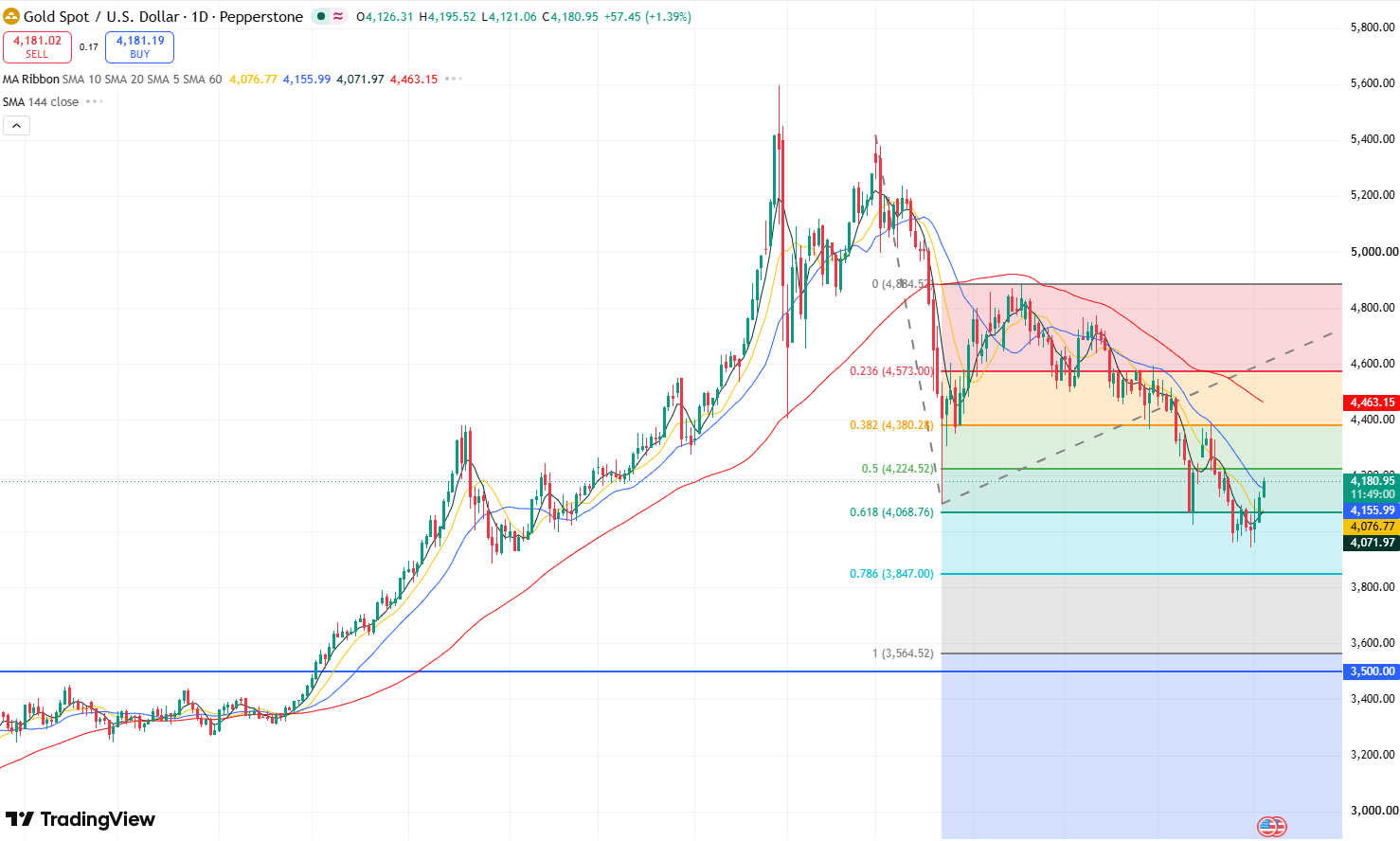
Gold Price Daily Chart, Source: TradingView
Looking at the daily chart, yesterday's gold price reclaimed the $4,100 level, fueled by the non-farm payrolls (NFP) data. The upward trend continued today, with prices briefly touching the $4,200 resistance level, signaling strong bullish momentum in the market.
On the upside, the immediate resistance level to watch is the psychological $4,200 mark. A breakout above this level would bring the $4,220 resistance into play, with the next key resistance further up at $4,380.
On the downside, the immediate support level to watch is the $4,100 mark, followed by further support at $4,070.
Currently, if today's closing price can confirm a breakout above the resistance of the SMA20—that is, establishing a firm foothold above $4,155—the short-term trend for gold will turn upward. Conversely, if today's closing price is below $4,155, gold prices may continue to test the psychological $4,000 level in the short term.
This content was translated using AI and reviewed for clarity. It is for informational purposes only.
Recommended Articles











Comments (0)
Click the $ button, enter the symbol, and select to link a stock, ETF, or other ticker.