Today’s Market Recap: SoftBank and Oracle Retreat on OpenAI Misses Amid NVIDIA’s ‘Nano’ Efficiency Breakthrough



AI Podcast


The S&P 500, Nasdaq, and Dow Jones declined due to tech sector losses, particularly AI firms like Oracle and CoreWeave, amid reports of OpenAI missing targets, though OpenAI denied this. General Motors, Coca-Cola, Chevron, and ExxonMobil saw gains. BigBear.ai surged on defense AI demand, while Iren fell on target reduction and infrastructure spending concerns. Erasca plummeted after a patient fatality in a trial. Cryptocurrencies consolidated. Geopolitical tensions rose with Iran, leading to U.S. sanctions, while a Japanese supertanker transited the Strait of Hormuz. The Fed is expected to hold rates steady, facing stagflation debates. The Bank of Japan kept rates unchanged, raising its inflation outlook. SoftBank dropped on AI revenue misses. NVIDIA launched its Nemotron-3 Nano Omni model for AI agents.

Track the Market Trend
TradingKey - The S&P 500 declined 0.49% to 7,138.80, the Nasdaq Composite fell 0.90% to 24,663.80, and the Dow Jones Industrial Average edged down 0.05% to 49,141.93, as losses in the technology sector outweighed gains in energy and defensive stocks.
Artificial intelligence (AI) equities faced downward pressure today, particularly firms associated with OpenAI, including Oracle and CoreWeave. Market sentiment was impacted by a Wall Street Journal report alleging that OpenAI had failed to meet its revenue and user growth targets — a claim the AI research firm officially denied this morning. In contrast, General Motors (GM) and Coca-Cola (KO) saw gains following robust quarterly earnings reports, while energy giants Chevron and ExxonMobil both ended the session in positive territory.
BigBear.ai (BBAI), a company providing AI solutions for the defense and digital identity sectors, rose 10.46% to close Tuesday at $4.12. The stock climbed as investors reacted to heightened trading volume and shifted their focus toward upcoming first-quarter earnings, specifically looking for demand trends in defense-oriented AI.
Iren (IREN), a vertically integrated data center operator specializing in Bitcoin mining and AI cloud services, dropped 8.11% to close at $44.44 on Tuesday. The decline followed a price-target reduction from Bernstein and renewed investor anxiety regarding AI infrastructure spending. Trading volume reached 39 million shares, approximately 5% above its three-month average of 37.1 million. Since its 2021 IPO, Iren has seen an overall growth of 82%.
Erasca (ERAS), a biotechnology firm developing therapies for RAS/MAPK pathway-driven cancers, plummeted 48% to close at $9.90 on Tuesday. The sell-off was triggered by the company's disclosure of a patient fatality due to pneumonitis during its ERAS-0015 trial. Investors are now awaiting more definitive safety data. Trading volume spiked to 51 million shares, roughly 709% higher than its three-month average of 6.3 million. Erasca has declined 43% since its 2021 public debut.
As of 5:00 PM ET, Bitcoin (BTC) was down 0.6% at $76,458.77, Ethereum (ETH) gained 0.3% to reach $2,296.30, and Solana (SOL) fell 0.5% to $83.87, as the leading cryptocurrencies continued to consolidate near their recent price levels.
Market Headline
U.S. media outlets report that Iran may submit a revised proposal to Washington through Pakistani mediators in the coming days, following Donald Trump’s dissatisfaction with Tehran's previous negotiation framework. Trump recently claimed that Iranian officials informed the U.S. that their country is "in a state of collapse" while grappling with internal leadership challenges. Meanwhile, the Iranian military has emphasized that the conflict is far from over, asserting "absolute control" over the Strait of Hormuz and mandating that all foreign vessels adhere to Iranian regulations and pay transit fees. In response, the U.S. has sanctioned 35 individuals and entities tied to Iran’s financial network. U.S. military officials stated that their maritime blockade has already forced 39 vessels to reroute, including a commercial ship intercepted in the Arabian Sea on Tuesday for allegedly violating the blockade.
In a significant development since the onset of hostilities, a Japanese-linked supertanker, the Idemitsu Maru, reportedly successfully transited the Strait of Hormuz. Carrying 2 million barrels of Saudi crude, the vessel followed a Tehran-approved northern route on Tuesday, marking one of the largest successful passages since the U.S. blockade began. While other Japanese ships have made the transit recently, those voyages were limited to non-oil commodities.
In the financial sector, "Fed Whisperer" Nick Timiraos writes that the Federal Reserve is expected to maintain current interest rates at its meeting this week. He notes that the specter of 1970s-style stagflation no longer seems distant, as the Fed faces a deep debate over whether to signal that rate cuts have been taken off the table entirely or merely postponed.
The Bank of Japan (BoJ) kept its benchmark interest rate steady at 0.75% in a divided 6–3 vote. The central bank significantly raised its inflation outlook while lowering its growth forecast for the 2026 fiscal year. Governor Kazuo Ueda maintained a hawkish tone, stating that the BoJ would continue to raise rates if economic conditions warrant, noting that the risk of price increases currently outweighs the risk of an economic downturn.
SoftBank’s stock suffered its largest single-day drop in six months after reports surfaced that OpenAI missed its 2025 revenue and user targets. The news reignited skepticism regarding AI investment returns, dragging down other "OpenAI proxy" stocks including Oracle, AMD, and CoreWeave. SoftBank fell nearly 10% as the market grappled with the dilemma of AI capital expenditure: while slowing down is viewed as a negative, accelerating investment now triggers concerns over long-term profitability.
NVIDIA (NVDA) has introduced its new Nemotron-3 Nano Omni model, which aims to boost efficiency by nine times for AI agent applications by integrating speech, vision, and reasoning. Despite its expanded multimodal capabilities, the model remains focused on cost-effective inference with 30 billion total parameters and 3 billion active parameters. It supports an ultra-long context window of up to one million tokens. While companies like Foxconn and Palantir have already adopted the model, others like Dell and Oracle are currently evaluating its integration.
Top 10 Most Traded Stocks
The chart below lists the ten most actively traded stocks in the market last Friday. Bolstered by massive trading volume and exceptional liquidity, these assets have become key benchmarks for tracking global market dynamics. 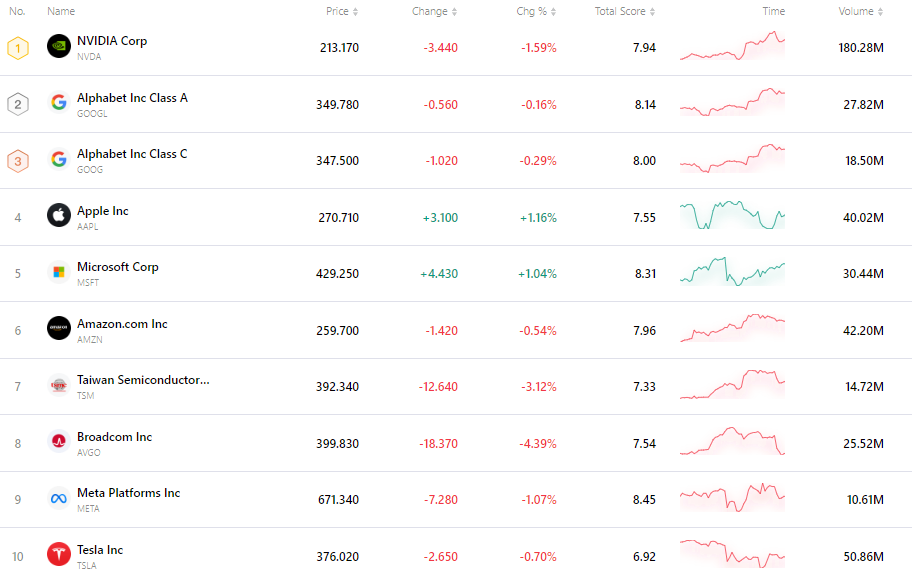
Recommended Articles