


Japan and South Korea Stocks Surge at Open: Nikkei 225 and Kospi Soar Together, SK Hynix and Kioxia Jump 8%, Samsung and SoftBank Follow



AI Podcast


Asia-Pacific markets rebounded on July 9, as the KOSPI Index rose 3.7% and the Nikkei 225 climbed 1.65%. Tech heavyweights like SK Hynix, Samsung Electronics, and Kioxia led the gains, bolstered by strong IPO demand and general market recovery. Despite this intraday relief, investor sentiment remains cautious. Surging WTI crude oil prices, exceeding $75 per barrel due to geopolitical tensions, pose significant risks to energy-dependent economies in Japan and South Korea. Higher energy costs threaten to impair corporate profitability and exacerbate domestic inflationary pressures, tempering the sustainability of the current rally.

TradingKey - Japanese and South Korean stock markets opened higher and continued to rise, with the KOSPI Index and the Nikkei 225 index recording various degrees of gains; SK Hynix and Kioxia surged about 8%, while Samsung Electronics and SoftBank followed suit.
During the Asian session on July 9, following yesterday's historic double-slaughter of longs and shorts and the futures circuit breaker tragedy, the Asia-Pacific markets welcomed a brief breathing space and recovery opportunity in early trading, with Japanese and South Korean stocks opening higher and continuing to rise today. Among them, South Korea's KOSPI Index surged 3.7% to temporarily trade at 7,514.67 points; the Nikkei 225 Index rose 1.65% to temporarily trade at 67,923.20 points.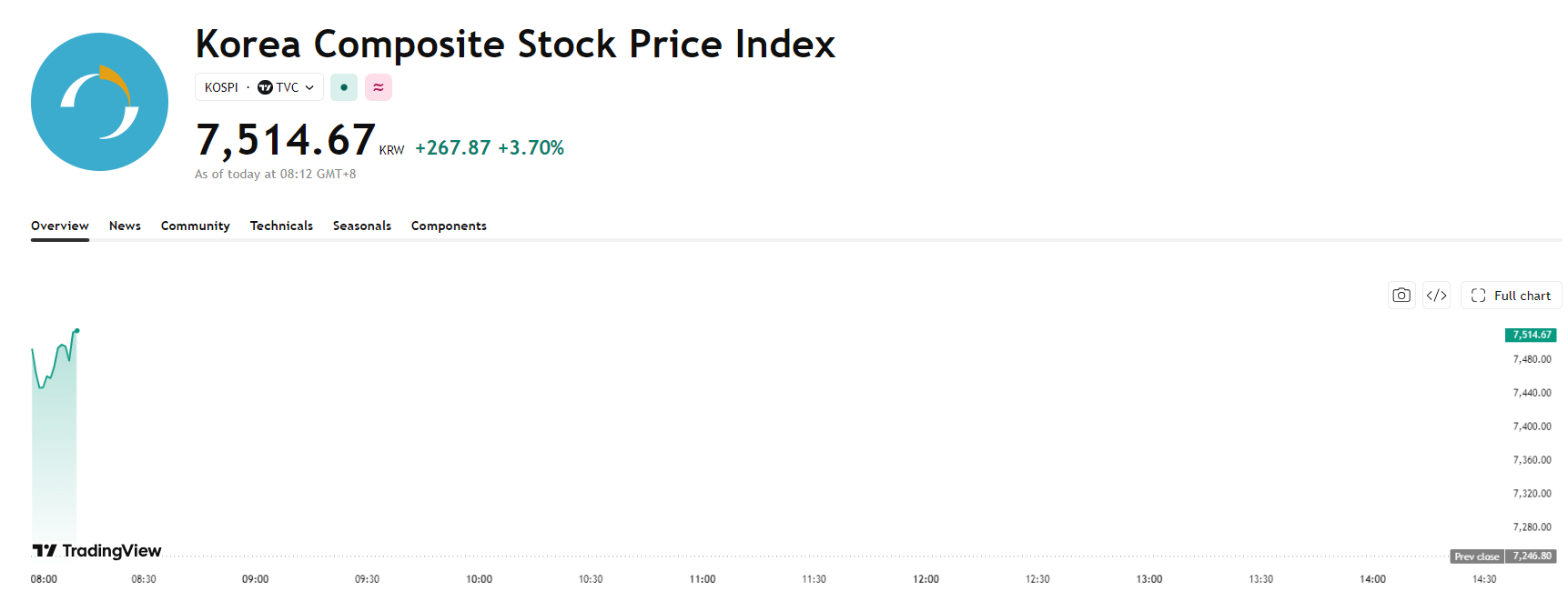 KOSPI Index Chart, Source: TradingView
In terms of individual stocks, heavyweight stocks rose across the board. Among them, SK Hynix's U.S. IPO was oversubscribed by more than 7 times, boosting its share price by 7.76% to temporarily trade at 2,237,000 KRW; Samsung Electronics jumped over 4% at the opening to temporarily trade at 289,000 KRW; Kioxia rose 8.14% to temporarily trade at 77,720 JPY; SoftBank rose 2.03% to temporarily trade at 5,880 JPY.
Although the Japanese and South Korean stock markets staged a rebound from deep losses at the opening, the sentiment of chasing highs in early trading remained extremely cautious. This was mainly because the commodity tsunami triggered by geopolitics is still spreading, with WTI crude oil breaking above $75 per barrel during intraday trading. For Japan and South Korea, which are highly dependent on energy imports, skyrocketing oil prices will directly deliver a secondary blow to corporate profitability and domestic inflation.
This content was translated using AI and reviewed for clarity. It is for informational purposes only.
Recommended Articles









Comments (0)
Click the $ button, enter the symbol, and select to link a stock, ETF, or other ticker.